
Warehouse Cooling Solutions For Hire
Keeping a warehouse at a workable temperature is one of the more underestimated operational challenges in UK industry. Metal roofing, constant door movement, and equipment running throughout the day all compound the problem, and by mid-afternoon on a warm day, internal temperatures can substantially exceed anything outside. Standard air conditioning was not built for this environment.
McCarthy Hire supplies industrial evaporative coolers to warehouses on flexible hire terms across the UK. Our units draw in fresh outside air, pass it through water-saturated filtration pads, and deliver it cooler, cleaner, and continuously refreshed, at a fraction of the running cost of a refrigerant system. Every unit includes integrated UV lamp technology as standard, actively suppressing the growth of Legionella and other waterborne bacteria within the water circuit.
Warehouse Cooling Challenges
Inadequate cooling rarely announces itself dramatically. It arrives as a dip in afternoon output, a rise in picking errors, a workforce visibly below capacity by 2pm. Left unaddressed, it is simultaneously a productivity problem, a financial liability, and a legal exposure.
Heat Build-Up in Large Warehouses
Metal roofing absorbs radiant heat throughout the day and continues releasing it well into the evening, which is why warehouse conditions frequently peak in mid-to-late afternoon. High ceilings, mezzanine levels, and dense racking create localised heat pockets that passive air movement cannot resolve. Opening roller shutters wider or directing fans at workers provides the impression of intervention. It does not constitute one.
Poor Airflow and Ventilation Issues
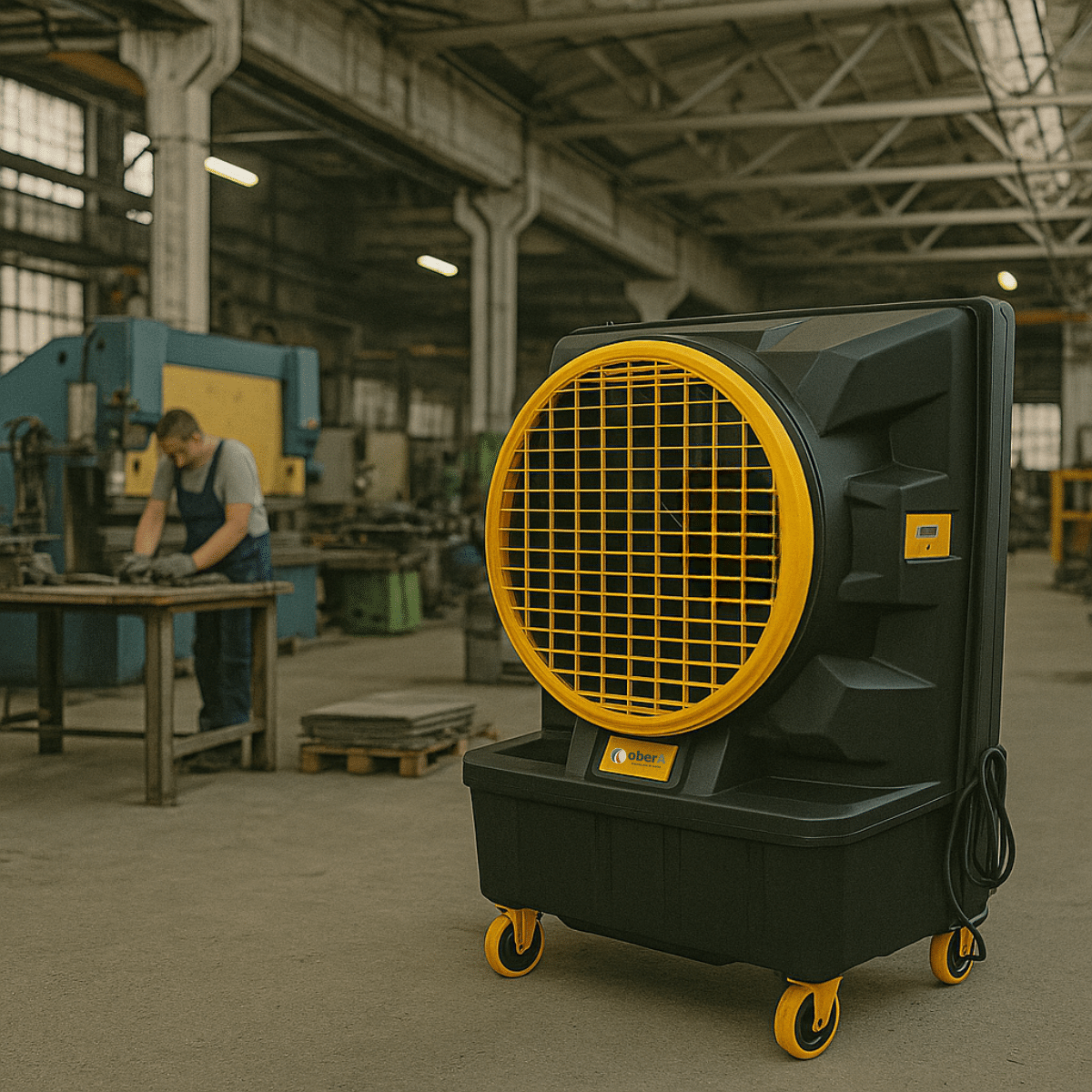
Passive ventilation (ridge vents, louvres, open loading doors) works adequately in mild conditions. When outside air is itself warm, it simply exchanges one warm air mass for another. Evaporative coolers introduce actively cooled, filtered air into the space, displacing warm air and producing consistent conditions across the floor rather than a patchwork of tolerable and intolerable zones.
Impact on Staff Productivity and Safety
The Workplace (Health, Safety and Welfare) Regulations 1992 impose a legal duty on employers to maintain a reasonable temperature in indoor working environments. The absence of a statutory maximum does not provide latitude to do nothing. The HSE requires heat to be assessed as a workplace risk with proportionate action taken, and Acas has confirmed that the duty of care applies in warm weather as in any other conditions.
The operational impact is well documented: picking accuracy declines, handling speeds reduce, and concentration degrades progressively across a shift. At elevated temperatures, heat stress becomes a genuine safety concern, disproportionately affecting those in the most physically demanding roles. Effective cooling is not a welfare provision. It is a core operational input.
Risks to Stock, Equipment and Operations
For operations handling food, pharmaceuticals, cosmetics, or electronics, sustained heat generates spoilage, write-off costs, and regulatory exposure that routinely exceed the cost of cooling. Some damage is immediately apparent; other consequences, shelf-life degradation or packaging failure, surface only once the product has moved further through the supply chain. Equipment is equally vulnerable: forklift infrastructure, conveyor systems, and sortation equipment running beyond their specified temperature range experience compressed service intervals and elevated fault rates.
High Temperatures Affecting Staff Productivity
The connection between heat and reduced productivity is well-documented and not subtle. Workers make more errors, move more slowly, and fatigue earlier when temperatures climb. The Workplace (Health, Safety and Welfare) Regulations 1992 place a legal duty on employers to maintain reasonable temperatures inside buildings, and while UK law stops short of setting a statutory maximum, the HSE is explicit that employers must assess the risk and act on it. Acas has confirmed the same: employers have a duty of care to keep working temperatures reasonable, including in hot weather.
None of that is new information. What gets overlooked is the commercial dimension. The hours lost to heat-related slowdown, the errors that need correcting, the sick days that spike in summer, these are real costs. Cooling is not a welfare gesture. It is a sensible operational investment.
Types of Warehouse Cooling Solutions
Evaporative Coolers
The recommended solution for the majority of warehouse environments. No recirculation of stale air, no requirement to seal the building, and energy consumption at approximately one tenth of an equivalent refrigerant system. They perform best in large, partially open environments, precisely the conditions that make conventional air conditioning impractical. All McCarthy Hire units include integrated UV lamp technology and multi-stage filtration as standard.
Refrigerant-Based Air Conditioning
Well-suited to contained, sealed spaces such as offices or temperature-controlled storage rooms within a warehouse. For the main floor, where doors open regularly and natural air exchange is continuous, it is expensive and largely ineffective.
Industrial Fans and Air Circulators
Increase perceived comfort through air velocity but do not reduce air temperature. When the building air is already warm, fans distribute the heat rather than remove it. Useful alongside active cooling, not as a substitute for it.
Destratification Fans
Ceiling-mounted units that return warm air from height to floor level. Primarily a winter heating tool; can assist with cooled air distribution in summer when used alongside an active system. Not a standalone cooling solution.
Permanent HVAC Installation
The appropriate answer where year-round, mission-critical temperature control is required and capital budget exists to fund it. For seasonal problems or bridging periods before a permanent system, hire is faster, more flexible, and considerably more cost-effective.
Which Cooling Solution Is Right for Your Warehouse?
Best Solutions by Warehouse Size
- Small (up to 500m²): A single well-positioned evaporative cooler typically covers the working area effectively. Draw from a cooler aspect of the building and direct airflow toward a natural exit point.
- Medium (500m² to 2,000m²): Multiple units deployed strategically across the building width or targeted at hotspot areas. Configuration advice is included in the quotation process.
- Large (2,000m²+): High-volume units, often combined with destratification to address warm air at height. A site assessment is advisable before committing to a configuration.
For very large sites, effective coverage comes from the right number of well-positioned units in combination, not a single high-capacity unit.
Best Solutions by Industry
- Logistics and distribution: Evaporative cooling across the working floor, with targeted provision at loading areas and despatch zones.
- Food storage and processing: Well-suited to ambient food warehouses. Cold rooms and refrigerated zones require specialist solutions; we can advise on integration within a mixed-temperature operation.
- Manufacturing and production: Positioning coolers alongside heat-generating equipment is more effective than attempting to condition the entire building uniformly.
- Retail and e-commerce fulfilment: Consistent conditions across the picking floor, where pick accuracy is both a commercial and welfare metric.
Climate and Environmental Considerations
The UK climate is well-suited to evaporative cooling for the majority of the year. The key variable is relative humidity: above 70% or so, the temperature reduction achieved is smaller because incoming air has less capacity to absorb additional moisture. On a typical UK summer day this is rarely limiting, though sites in consistently humid microclimates should raise this at enquiry. Evaporative coolers operate at 80 to 90% lower electricity consumption than equivalent refrigerant systems, a material consideration for operations with energy or sustainability targets.
Temporary vs Permanent Cooling Solutions
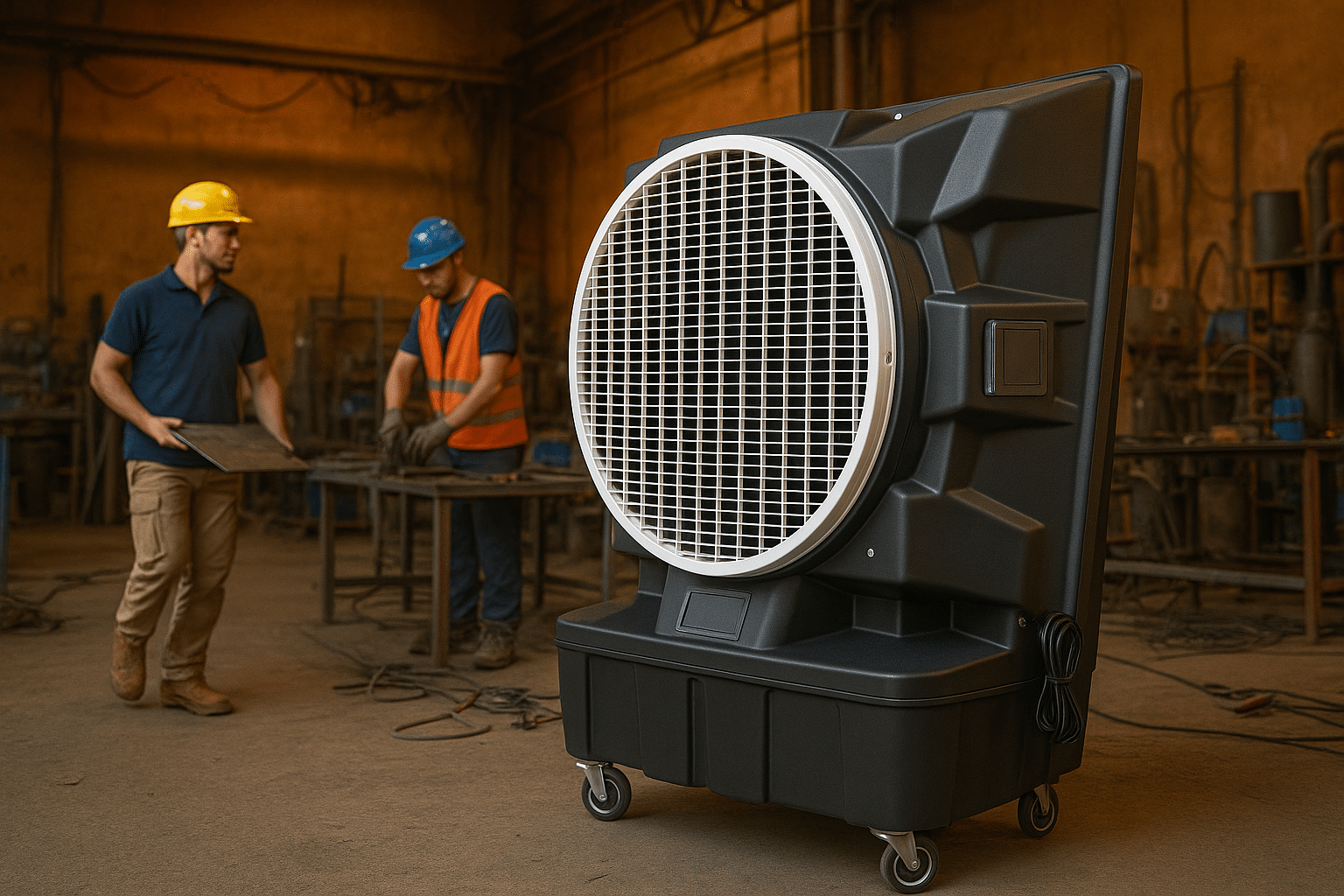
Hire is the right choice for seasonal requirements, emergency cover, and growing businesses unwilling to commit capital to equipment that may not suit their next premises. Permanent installation is appropriate where year-round temperature control is operationally critical and budget exists to fund it. For most warehouses managing a seasonal challenge, hire resolves it faster, more flexibly, and at lower total cost. We will give you an honest assessment of which suits your situation.
Cost of Cooling a Warehouse
Our hire pricing is transparent and all-inclusive: the figure quoted covers the unit, delivery, and maintenance support for the hire period, with no supplementary call-out charges. Rates are determined by unit size and airflow specification, number of units, hire duration, and delivery distance.
Running costs are worth placing in context. Evaporative coolers consume approximately 80 to 90% less energy than refrigerant-based systems. Over a three-month summer hire, the electricity differential alone often materially alters the total cost comparison.
The cost of not cooling is harder to model but straightforward to outline: lost output, reprocessing errors, stock write-offs, maintenance on equipment running beyond temperature specification, and the compliance exposure that comes with failing to assess a risk the HSE requires to have been formally addressed. None of these are marginal.
To receive a quotation, contact the team or complete the enquiry form.
Energy Efficiency and Sustainability
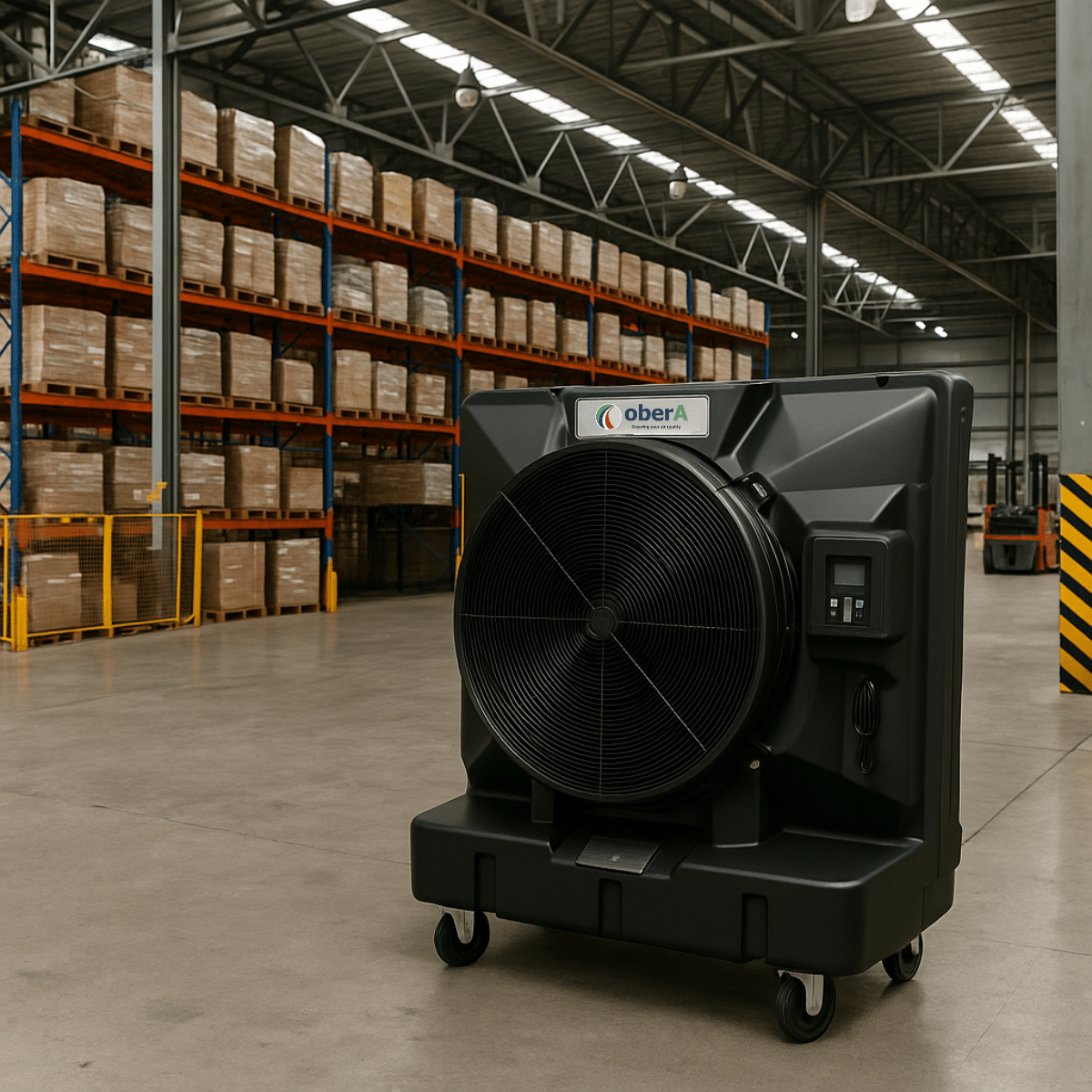
Evaporative cooling is by a significant margin the most energy-efficient active cooling technology available for warehouse environments. A refrigerant system drives a compressor through a thermodynamic cycle. An evaporative cooler uses a fan and a small water pump. That mechanical difference is the source of 80 to 90% lower electricity consumption compared to a refrigerant system of equivalent capacity, a saving that is material in both cost and carbon terms for any warehouse operating through the summer months.
Water consumption is a factor to acknowledge: the process depends on evaporation, so units do use water in normal operation. Volumes are modest relative to the cooling delivered, but sites with metering or usage targets should include this in their assessment.
Our UV lamp technology keeps the water circuit biologically clean without chemical dosing agents. No biocides enter the water supply and there is no chemical waste to manage at the end of the hire period.
Why Choose McCarthy Hire for Warehouse Cooling?
McCarthy Hire is the equipment hire division of McCarthy Group, a business with deep roots in industrial health, safety, and compliance. That background determines which equipment we stock, how we specify it, and our understanding of what a hire unit needs to deliver in a real workplace.
UV Lamp Technology: Waterborne Risk, Managed as Standard
Water-based cooling systems create conditions that can support bacterial growth if the water circuit is not actively managed. Legionella pneumophila, the organism responsible for Legionnaires' disease, thrives in warm, recirculating water at the temperature range typical of a cooling circuit. In a warehouse where workers are present across a full shift, day after day, this is not a theoretical risk. It is a live one that requires active control.
Every unit in the McCarthy Hire range incorporates UV lamp technology within the water circuit as a standard feature. UV-C light at 254 nanometres disrupts the DNA of microorganisms, preventing reproduction without chemical treatment, without additives, and without any requirement for manual intervention during operation. This is not a premium option or an upgrade tier. It is a baseline specification, because in our view, any water-based unit deployed in an occupied workplace should have it as a matter of course.
Multi-Stage Air Filtration: Cleaner Air, Not Just Cooler Air
The water-saturated cooling pads serve two functions simultaneously. They reduce the temperature of incoming air through evaporation, and they filter it, capturing dust, pollen, and airborne particulates before the air enters the warehouse. In an environment where forklift traffic, pallet handling, and active picking operations maintain elevated particulate levels throughout the working day, this filtration produces a measurable improvement in the air quality your workforce is exposed to.
Evaporative cooling also replaces air rather than recirculating it. Every operational cycle draws in fresh outside air. The system is not cleaning and returning the air already in the building; it is gradually displacing it. Air quality does not stabilise at a fixed point. It improves progressively the longer the units run.
Part of the McCarthy Group: Compliance Is Our Core Business
McCarthy Hire operates alongside McCarthy Environmental, our LEV testing and COSHH compliance specialists. When you engage McCarthy Hire, you are working with a supplier that understands your compliance obligations from operational experience and will tell you directly if a solution is not appropriate for your site.
Responsive, Practical Service
Cooling requirements rarely arise on a convenient schedule. Our team responds promptly, produces quotations without unnecessary process, and mobilises equipment quickly. You deal with the people responsible for the job, no call centres, no departmental routing.
FAQs About Warehouse Cooling Solutions
Why is my warehouse so much hotter than outside?
A combination of factors compound to make internal temperatures worse than the external environment alone would produce. Metal and steel-clad roofing absorbs radiant heat throughout the day and continues releasing it back into the building for several hours after the sun has moved, which is why warehouse temperatures frequently peak in mid-to-late afternoon rather than at noon. The volume of air inside a large building warms gradually but retains that heat effectively once accumulated. Machinery, vehicles, and personnel all contribute to the thermal load. And passive ventilation (ridge vents, louvres, open loading doors) moves air without reducing its temperature. When outside air is itself warm, exchanging one warm air mass for another produces no net cooling. Active cooling, which actually reduces the temperature of incoming air before it enters the building, is the only intervention that reliably breaks that cycle.
Will evaporative cooling work in a warehouse with the doors open?
Yes. Open doors are not a constraint on the performance of an evaporative cooling system. The common misconception typically arises from familiarity with refrigerant-based systems, which require a sealed environment to function effectively. Every time a door opens on a refrigerant system, conditioned air is lost and warm air enters, increasing the load on the compressor. Evaporative cooling operates on an entirely different basis. It draws in fresh outside air continuously, cools it, and distributes it through the space. Open doors are a feature of the airflow management, not a problem for it. Warehouses with busy loading bays, regularly operated roller shutters, and high levels of pedestrian and vehicle traffic are among the most suitable environments for evaporative cooling.
How many units do I need for my warehouse?
Unit requirements depend on floor area, ceiling height, the nature and location of heat sources, and the internal configuration of the space. A clear-span warehouse and one with racking running to 10 metres have significantly different airflow characteristics despite potentially sharing the same footprint, and the cooling specification needs to reflect that. Our team will gather the relevant information about your site before making a recommendation, rather than estimating from floor area alone. For most medium to large warehouses, a configuration of multiple units with considered placement outperforms a single high-capacity unit, and positioning is as important a variable as aggregate airflow.
Is there a legal maximum temperature for warehouse workers in the UK?
There is no statutory maximum temperature in UK law. The Workplace (Health, Safety and Welfare) Regulations 1992 require employers to maintain a reasonable temperature in indoor working environments, and the HSE's Approved Code of Practice sets minimum thresholds (13 degrees Celsius for physically demanding work, 16 degrees for lighter tasks) without applying equivalent prescription to the upper end of the scale. The legal requirement that does apply is for a thermal comfort risk assessment to be conducted and for proportionate action to follow where heat presents a risk to workers. Acas has confirmed that the duty of care is not suspended in warm weather. The absence of a specific upper limit does not limit the employer's obligation to act where conditions affect the safety or performance of the workforce.
What is the UV lamp for, and is it necessary?
The UV lamp is integrated into the water circuit and functions to prevent the growth of Legionella and other waterborne bacteria within the unit. Water at the temperatures typical of a cooling circuit, warm, recirculating, and in regular contact with ambient air, provides conditions in which bacterial populations can establish rapidly if nothing is working against them. UV-C light disrupts the DNA of microorganisms, preventing reproduction without the use of chemical agents, additives, or any requirement for ongoing manual management once the unit is in operation. Whether UV treatment is strictly required under your specific risk assessment is a matter for your health and safety team to determine. Our position is unambiguous: it is a baseline requirement for any water-based cooling unit deployed in an occupied workplace, and it is fitted to every unit in our hire range.
Can I hire units for just the summer months?
Yes. Seasonal hire is the most common arrangement we provide. Units are deployed in spring and returned at the end of the summer period, with hire terms as long or short as your requirements dictate. For operations that want the option to extend the arrangement annually without committing to a long-term contract, rolling arrangements are available. If guaranteed availability during peak summer weeks is a priority, we recommend reserving in advance. Demand increases significantly from May, and planning ahead removes the risk of competing for stock during a heatwave.
How quickly can units be delivered and made operational?
For most sites within our primary delivery area, delivery can be achieved within 24 to 48 hours of a confirmed order. Installation requires a standard mains power connection and a water supply, either mains-fed or from an external tank. No specialist engineers are required on site, no F-Gas certification applies, and no refrigerant handling is involved. Units are typically operational within a few hours of delivery. Contact us directly for an accurate lead time for your specific location.
What maintenance is required during the hire period?
Day-to-day maintenance requirements are minimal. Units are built for sustained operation in demanding industrial environments with limited intervention. Routine tasks are limited to maintaining the water supply and periodically checking that the filtration pads are free of debris accumulation, with greater frequency appropriate in particularly dusty environments. The UV lamp operates continuously and requires no user input. In the event of a fault during the hire period, repair or replacement is provided at no additional cost. The price agreed at the outset is the price paid.
Talk to our Specialists
Our team is here to help you select the right unit for your application and to ensure full compliance from day one.